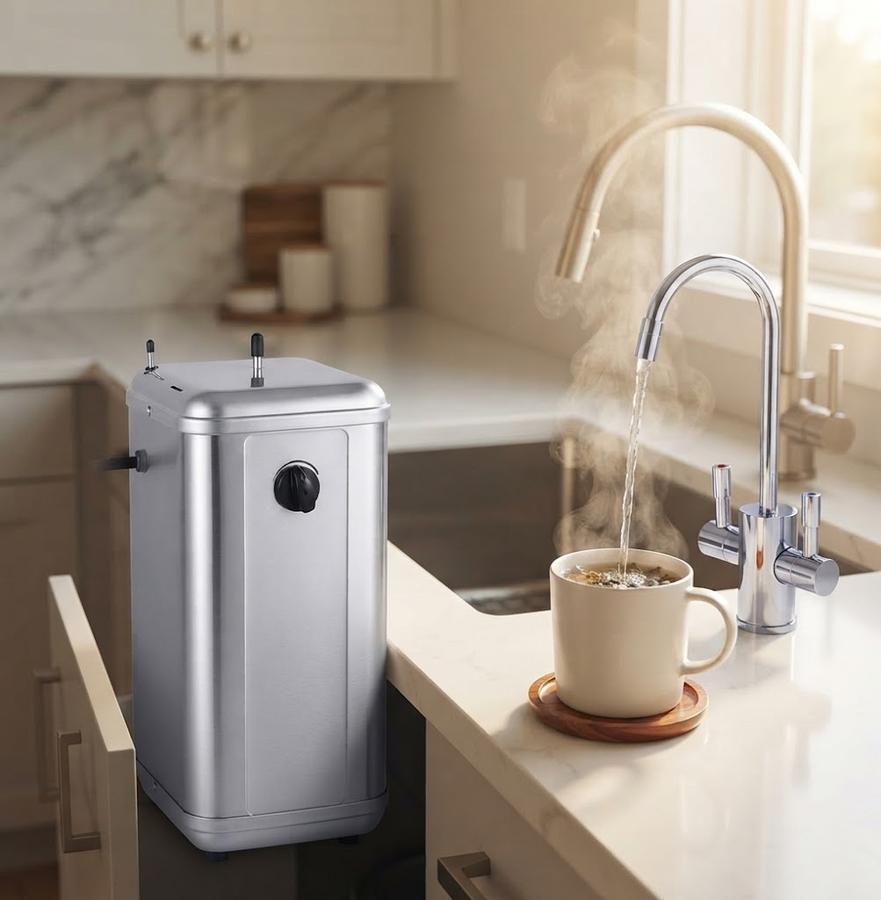
Ready Hot Instant Hot Water Dispenser

Year 3 in, your last under-sink tank corroded at the bracket joint and dripped into the cabinet. Ready Hot answers that with a 2.5-quart stainless tank, a 3-year manufacturer warranty, and 4.1★ across 686 verified buyer reviews. Those reviews name the failure point too, and this page marks exactly where it starts.

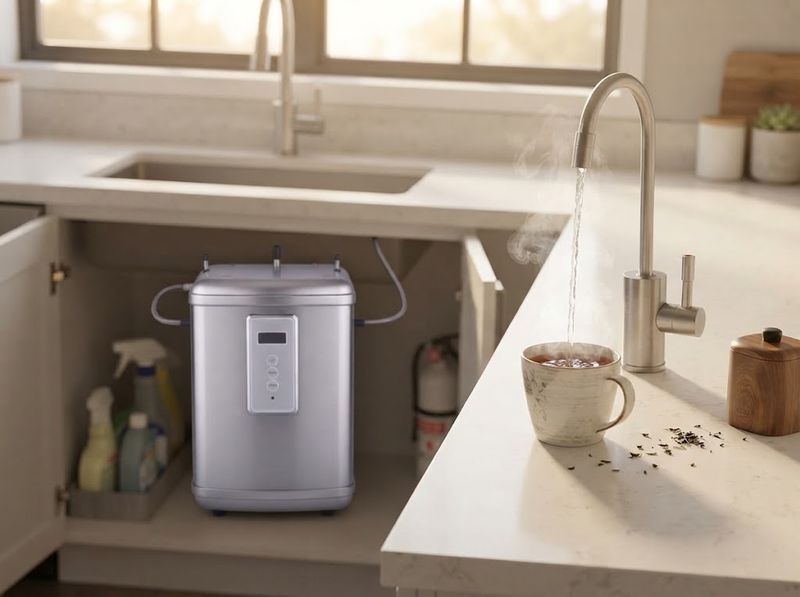
Fill a mug at 8 a.m. and the water lands near-boiling: no kettle on the counter, no three-minute wait at the stove. The stainless tank rests on rubber feet under the sink and reheats while you finish the pour. Turn the dial down to 175°F for green tea, or run the digital model at 208°F when you want pour-over water without clipping a thermometer to a kettle.

Output, Coverage, and Burnout Protection

  • Draw 60+ cups of near-boiling water an hour without refilling anything
  • Three years of tank coverage and one year on the faucet, original receipt required
  • A self-resetting thermal fuse opens the circuit before an empty tank cooks the element
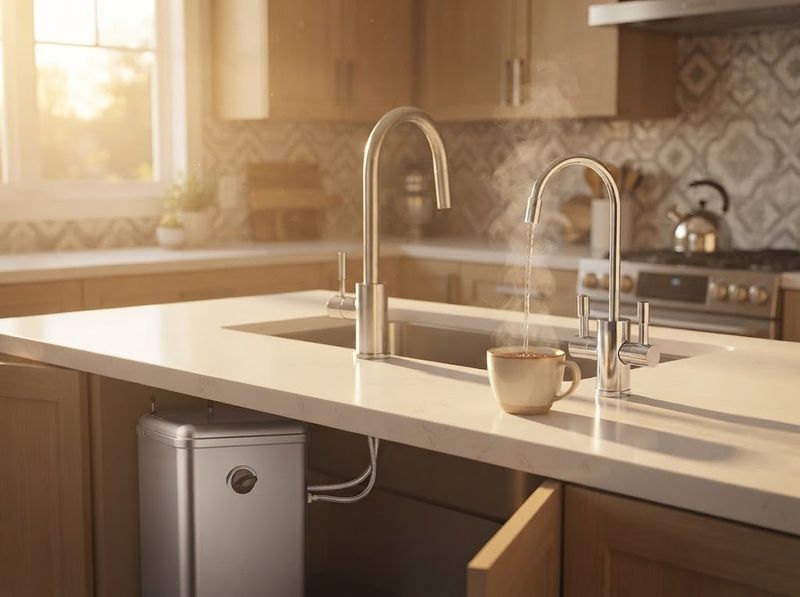
Chrome instant hot water faucet at a kitchen sink with a steaming mug

What Every Ready Hot Tank Ships With

Coverage terms, burnout protection, and the install spec you need before a drill bit touches the counter.

3-Year Tank Warranty

One year on the faucet, three on the tank. The original sales receipt is the only paperwork a claim asks for, so photograph it the day the box lands.

Self-Resetting Thermal Fuse

Plug in before the line is bled and the cutout opens the circuit within seconds, then closes again on its own once water fills the reservoir.

Under-Sink DIY Install

A 1-3/8 inch counter hole and a 110-120V outlet finish the job. The tank rests on rubber feet or takes two screws into the cabinet wall.

Every Ready Hot Tank and System

Every Ready Hot under-sink instant hot water tank runs the same 2.5-quart stainless reservoir; faucet and controls set the models apart.

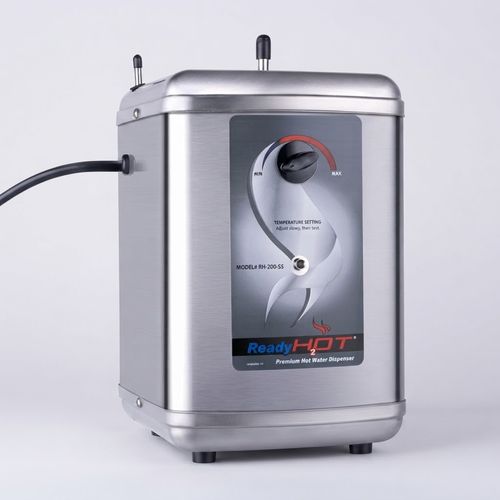
Ready Hot Manual Dial Hot Water Tank — Stainless Steel

Manual Dial Hot Water Tank, Tank Only

★ 4.0 (394 verified reviews)

Swap a leaking tank out on a Saturday morning and keep the faucet already sitting in your counter: this unit ships as the tank alone, no spout in the box and no new hole to drill. The manual dial runs 140°F to 200°F, and the stainless element brings the 2.5-quart reservoir back up fast enough that the fourth mug of a tea round arrives as hot as the first. Where a full system forces a fresh countertop cutout, this one asks for nothing above the counter, provided the existing spout is an open-vent Ready Hot faucet. At 3.5 pounds with a self-resetting thermal cutout standard, it is the entry-tier straight replacement.

  • Drops into the old tank's cabinet corner and reuses your existing open-vent faucet, no new counter hole
  • The stainless element recovers the 2.5-quart reservoir between draws, so a tea round never runs lukewarm
  • Where a full system needs a fresh countertop cutout, the tank-only unit needs nothing above the counter
Check today's price
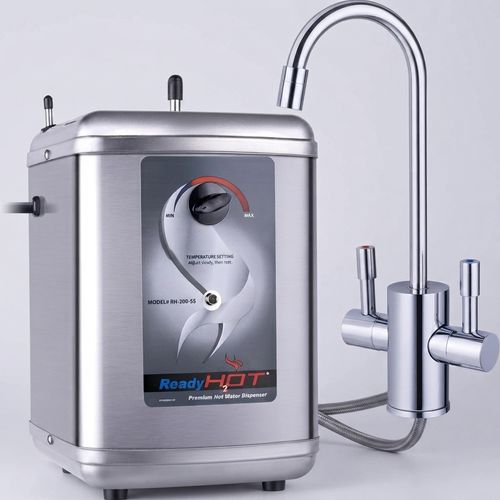
Ready Hot Manual Dial System — Polished Chrome Hot and Cold Faucet

Manual Dial System, Chrome Hot & Cold Faucet

★ 4.2 (215 verified reviews)

Cut one counter hole and this system covers both taps: a polished chrome dual lever hands you near-boiling and cold water from the same spout, with the tank working underneath. The mounting hardware torques down from the counter surface, so nobody spends twenty minutes on their back holding a nut against a faucet body that keeps spinning. Where most dispenser faucets get tightened blind from below, this one is seated and squared while you are still standing at the sink. A depress-and-rotate lever lock keeps a curious five-year-old away from a scald, and the tank carries the same dry-startup cutout as every other model.

  • One counter hole feeds both near-boiling and cold water through a single chrome dual lever
  • The faucet nut torques from above the counter, so the spout stays squared while you tighten it
  • Rated 4.2★ across 215 verified buyer reviews
Check today's price
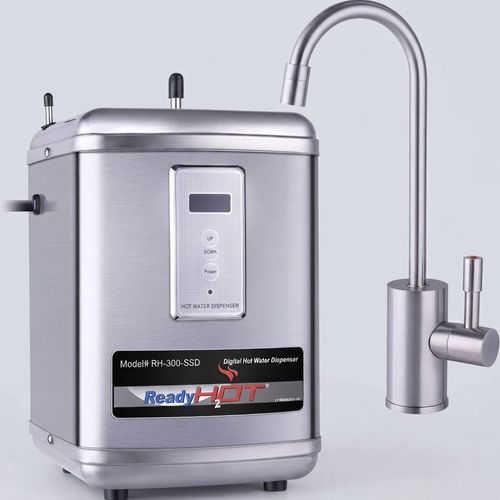
Ready Hot Digital Display System — Brushed Nickel Single Lever Faucet

Digital Display System, Brushed Nickel Faucet

★ 4.1 (77 verified reviews)

Key an exact number instead of guessing at an unmarked knob: the digital pad sets any temperature from 140°F to 208°F in 1° steps and shows the live tank reading beside the target. That readout matters most right after a draw, because you can see whether the tank has climbed back to your number or still needs two minutes before the next pour-over. Where an analog dial takes a week of trial and error to land on a setting, this one repeats it exactly every morning. Brushed nickel single lever, 13.4 pounds of tank and hardware, and an on-off button that shuts the element down for a vacation.

  • Set 202°F for pour-over and the pad shows the live tank temperature climbing to meet it
  • Digital control repeats the same set point after every draw, where an unmarked dial drifts by feel
  • Rated 4.1★ across 77 verified buyer reviews
Check today's price

Why Owners Replace a Failed Tank With This One

Owners buying a second tank check the same specs first: 60+ cups per hour, temperature ceiling, faucet fit, install method.

Claim a Failed Tank Any Time Before Year Three

Keep the original receipt somewhere findable: one owner whose tank quit at month 16 had a free replacement in hand inside a week.

Pour Cup After Cup Through a Full Dish Run

The 2.5-quart tank recovers fast enough for 60+ cups of near-boiling water an hour, so the fourth mug lands as hot as the first.

Pull the Kettle Off the Counter for Good

Toss the corded kettle in a donation box and take back the counter strip beside the sink it held hostage for years.

Start the Instant Pot With Water That Is Already Hot

Picture a Tuesday rice batch: one owner clocked about five minutes off the cook cycle by filling the pot from the hot tap.

Tighten the Faucet From Above the Counter

Stand at the sink and turn the mounting nut down from the top, instead of lying on your back holding a wrench you cannot see.

Survive a Dry Startup on Any Model, Not Just the Flagship

Plug in before the line is bled and the cutout opens the circuit, then closes again on its own once water fills the tank.

From Carton to First Cup Without a Plumber's Van

Set the tank, wire a dedicated 110-120V circuit, connect the quick-connect lines, then dial in the temperature you drink at.

  1. Set the Tank

    Rest it on the rubber feet, or drive two screws through the rear holes into the cabinet wall.

  2. Wire the Circuit

    Give the 1,300-watt element its own 15 or 20 amp 120V breaker, not the disposal outlet.

  3. Connect the Lines

    Push the quick connectors onto the cold supply and faucet lines, then flush five minutes before power.

  4. Dial the Temperature

    Turn the dial to 175°F for tea, or key an exact number into the digital display.

The Situations the Tank Was Engineered Around

Pour-over temperature in 1° steps, faucet compatibility, filter placement, and burnout protection: the decisions that shape daily use.

Ready Hot digital display hot water system — Brushed Nickel

Dial In the Exact Degree for Pour-Over Coffee

The digital model holds a set point anywhere from 140°F to 208°F in 1° steps, which covers the 195-205°F window most pour-over guides call for. Key in 202°F on a Saturday morning, watch the readout climb, and pour over the grounds without a separate thermometer clipped to a kettle. The manual dial stops at 200°F, unmarked, so tea drinkers set it once by taste and leave it there.

  • Key 202°F into the pad at 6 a.m. and the readout shows the live tank temperature, not just the target.
  • The pad repeats the same set point after every draw because it reads the tank, where an unmarked dial drifts.
  • Turn the manual dial about three-quarters up and the water lands near 180°F, the setting owners land on for green tea.
See the digital display model
Ready Hot chrome dual-lever hot and cold faucet system

Keep the Tank Coverage Valid With the Right Faucet

Reusing an old sealed kitchen faucet is the single fastest way to void tank coverage: Ready Hot tanks vent through the spout and pair only with an open-vent Ready Hot faucet. A sealed spout traps the steam the tank has to release, which is why the requirement sits in the product terms rather than buried in a manual. Owners who carried a previous matching faucet onto a replacement tank kept their claim intact. Owners who fitted another brand's spout did not.

  • Check the existing spout for a vent gap before ordering a tank-only unit, not after the box lands.
  • The tank sheds heat and pressure through the faucet because nothing inside it is pressurized, so a sealed spout fails it.
  • Where a mismatched faucet leaves you arguing at year two, the matched open-vent one keeps the claim to one phone call.
See the open-vent faucet system
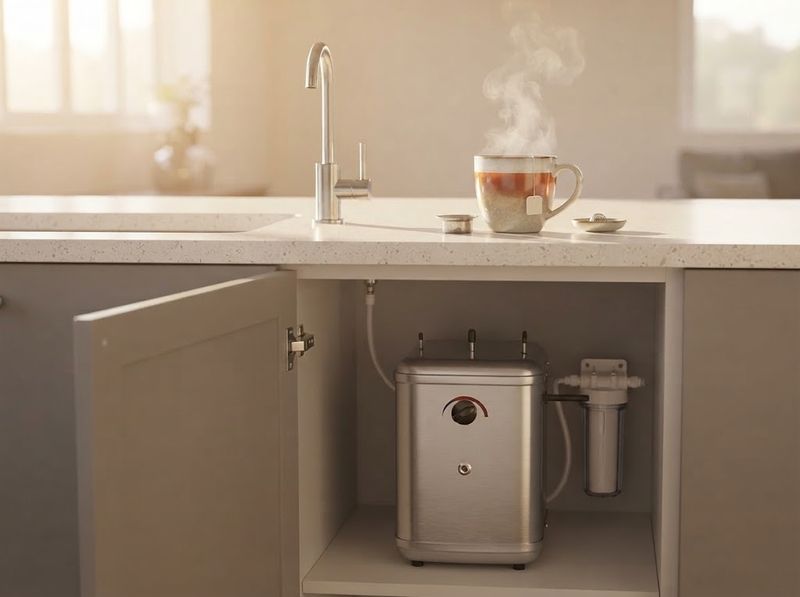
Under-sink cabinet with a filter housing plumbed ahead of a stainless hot water tank

Put the Filter Ahead of the Tank, Never Inside It

Ready Hot tanks ship without an inline filter, so filtration belongs on the cold supply line ahead of the tank, never inside it. Owners running reverse osmosis tee the tank into the RO output and draw filtered near-boiling water from the same spout. One owner fitted an under-sink carbon housing upstream and reported tea tasting cleaner than straight tap. A separate inline filter accessory covers cabinets with no RO housing already in place.

  • Trace the cold line back to the shutoff before buying: the filter housing goes between that shutoff and the tank.
  • Filtering upstream keeps scale off the element because the minerals never reach 200°F inside the reservoir.
  • Where a hot-side filter would cook its own carbon media, an upstream housing works at room temperature for months.
Compare the digital system
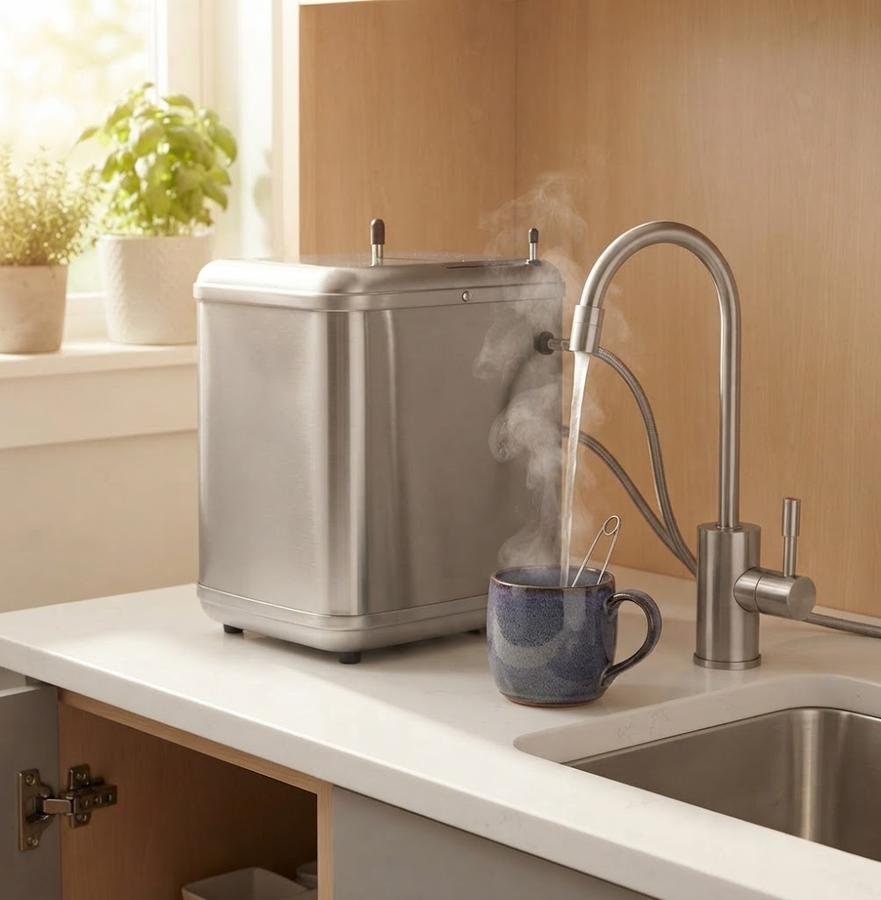
Ready Hot stainless steel hot water tank, manual dial tank-only unit

Survive a Dry Startup Without a Burned-Out Element

Every Ready Hot model carries a self-resetting thermal fuse, the part that saves a tank when someone plugs it in before the line is bled. Power an empty tank and the element climbs fast with nothing to absorb the heat, so the fuse opens the circuit before the coil cooks itself. Once water fills the tank and temperature drops, the fuse closes again on its own. No trip to the hardware store, no replacement part, no service call.

  • Plug the tank in before flushing the line and the fuse trips within seconds, well before the element burns.
  • The fuse resets itself because it reads temperature rather than blowing a filament, so nothing needs replacing after a dry run.
  • Where budget tanks reserve burnout protection for a premium tier, this one ships it on the tank-only unit too.
Compare the tank-only unit

The Numbers Most Under-Sink Guides Leave Vague

Ready Hot publishes wattage, temperature ceiling, hourly output, and coverage length: the figures that decide this purchase and rarely surface elsewhere.

1,300W on a standard 15A/120V outlet

Plug the tank into a standard 120V outlet inside the cabinet: the 1,300-watt draw sits under a 15-amp breaker, so no service panel upgrade joins the install list.

Buyers keep asking whether this needs a heavy-duty circuit, and install write-ups say plug it in without ever naming the draw.

Manufacturer spec

up to 208°F in 1° steps

Set 202°F on the digital pad the night before a pour-over morning: the 208°F ceiling clears the 195-205°F brew window without a kettle thermometer.

Temperature sections call a range adjustable without saying how close to boiling the tank actually gets.

Manufacturer spec

60+ cups per hour from a 2.5-qt tank

Fill mug after mug through a dinner-party cleanup: the 2.5-quart reservoir recovers fast enough for 60+ cups of near-boiling water an hour before it runs lukewarm.

Capacity write-ups call a tank enough for a household and skip the per-hour number you would plan a busy sink around.

Manufacturer spec

3-year tank / 1-year faucet

Replace a tank that quits at month 20 without paying twice: tank coverage runs three years from the receipt date, with the faucet backed one year.

Coverage gets a passing line on most product pages, and the tank-specific length rarely gets a number of its own.

Manufacturer spec

4.1★ from 686 verified reviews

Read the one-star reviews before ordering: 686 verified buyer reviews averaging 4.1★ give enough depth to spot the leak pattern before it surprises you at year three.

An unbranded tank rarely carries a verified rating pool deep enough to check a failure pattern against.

686 verified buyer reviews

1-3/8 inch faucet hole

Mark a 1-3/8 inch circle on the counter before the drill touches stone: that diameter fits the faucet shank without a template or an oversized cutout.

Install guides say drill a hole and leave out the diameter you need before cutting into a countertop.

Manufacturer spec

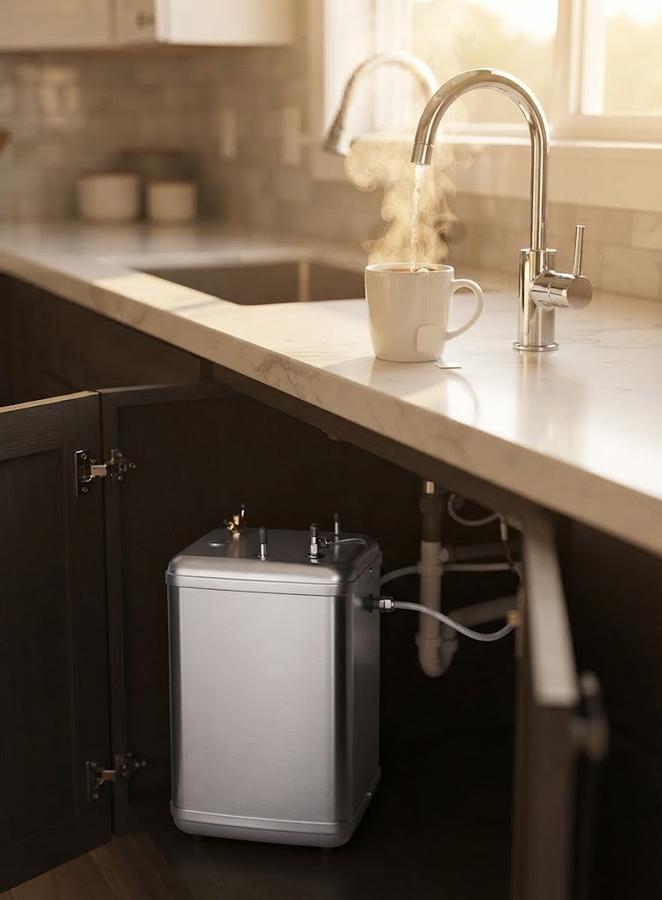
Ready Hot stainless tank installed inside a kitchen sink cabinet

The Company Behind the Tank Under Your Sink

Joneca Corporation has built kitchen and bath fixtures out of Anaheim, California since 1985, and Ready Hot is its instant-hot-water brand. That matters less than what owners find at year three. Search the verified reviews and you will hit the same report more than once: a stainless tank corroding where an aluminum bracket meets it, then weeping into the cabinet below.

Two dissimilar metals sitting in water behave like a slow battery, and the joint gives first. The honest read is that you are buying a tank with published coverage against that failure, not a tank that never fails. One owner ran a unit seven years before the side let go. Another lost one at sixteen months and had a free replacement in hand within a week of a phone call.

Put a drip pan and a leak alarm under your sink cabinet the day you install, keep the receipt where you can find it, and the worst case costs you an afternoon instead of a floor. More on the company behind Ready Hot and how the tanks are built.

Read the full Ready Hot story

What Owners Report After Year One

Install stories, a measured standby draw, a claim closed in a week, and the corrosion pattern owners name themselves.

4.1★ average across 686 verified reviews

★★★★★ Verified Purchase

I wondered about the power cost of holding 2.5 quarts near boiling around the clock, so I put a plug-in meter on it. Twelve hours of standby drew 0.21 kWh, roughly 0.42 kWh a day. At my rates that is a few cents, which I will pay for the convenience. I set mine to 190°F to keep a scald unlikely, and the heating unit carries a UL marking.

Daniel R. Manual Dial System, Chrome Faucet

★★★★☆ Verified Purchase

Sixteen months after installation mine stopped heating: the indicator lit but the water never got hot. Getting it replaced under the tank warranty turned out to be painless. The toll-free number was answered by a live person, I emailed my proof of purchase, and the replacement arrived within a week at no charge. Swapping the units under the sink took about twenty minutes.

Marianne P. Manual Dial System, Chrome Faucet

★★★★★ Verified Purchase

I bought this to replace a failed tank and to get the digital control. It runs quieter than the old one, which made a loud boiling sound while heating. The readout is large and bright red, so I can read it from outside the cabinet, and setting a number beats an unmarked knob by a mile. The on-off button means I no longer unplug anything before a trip.

Greg T. Digital Display System, Brushed Nickel

★★★★☆ Verified Purchase

This is the first faucet I have installed without lying under the sink, and the mounting design deserves the credit. It also needs one cold water feed where my older brand wanted two. The lever lock on the hot side matters with a five-year-old in the house. I would give it a fifth star, but the printed sheet assumes you already work as a plumber.

Hector V. Manual Dial System, Chrome Faucet

★★★★☆ Verified Purchase

My previous tank started weeping where the aluminum bracket meets the stainless shell. Two dissimilar metals sitting in water, and that joint gives first. I bought the same unit again anyway, because it ran three years and the coverage is real. This time a drip pan and a leak alarm went under the cabinet on install day, which took all of ten extra minutes.

Lorraine K. Manual Dial Tank Only

★★★★★ Verified Purchase

I measured the counter hole at 1-3/8 inch before ordering, so the faucet dropped straight in. At 6,000 feet water boils below the pad's ceiling, which makes keying an exact number far more useful than chasing a dial to its top stop. The handle interlock takes a deliberate push before it rotates, and my previous unit had nothing like it.

Priya S. Digital Display System, Brushed Nickel

★★★★★ Verified Purchase

I start recipes with near-boiling water now, and the pressure cooker reaches pressure about five minutes sooner on a weekly rice batch. I also drink far more tea than I used to, because a cup takes seconds instead of minutes. Hot and cold from one spout meant a single extra hole in the sink, and the lever moves smoothly after a year of daily use.

Alice M. Manual Dial System, Chrome Faucet

★★★★☆ Verified Purchase

Third tank in this kitchen, and this one is holding up better than either predecessor. Easy install, works as described, and I keep the dial a little past three-quarters rather than maxed out because the element seems to last longer that way. My brother has run the same tank at 180°F for eight years on one setting.

Wes D. Manual Dial Tank Only
Spec by Spec Against the Tank You Almost Bought

Temperature precision to 1°, hourly output, burnout protection, and install method, measured against the InSinkErator, Waste King, and Franke tanks owners replace.

Criterion Ready Hot Budget under-sink tanks InSinkErator / Waste King / Franke
Tank warranty length 3 years from the original receipt date Commonly 1 year; confirm the term before ordering Varies by model; owners report honored claims but repeat failures
Faucet warranty length 1 year on the faucet, listed separately from the tank Often folded into a single combined term Varies by model; check the current spec sheet
Temperature precision 140°F-208°F in 1° steps on the digital model; 140°F-200°F on the dial Unmarked analog dial, set by trial and error Dial or fixed preset stops on most under-sink models
Output rate 60+ cups of near-boiling water per hour from 2.5 quarts Capacity published, hourly recovery rarely is Capacity published, hourly recovery rarely is
Dry-startup protection Self-resetting thermal fuse on every model, tank-only unit included Often reserved for the higher tier Included on most current models; verify per model
Faucet install style Tightened from above the counter while you stand at the sink Under-sink nut, tightened lying on your back Under-sink mounting on most designs
Verified review depth 4.1★ across 686 verified buyer reviews Thin review pools on unbranded tanks Deep review pools; compare failure patterns, not just averages

Day 1 to Year Three Under the Same Sink

Day 1 through year three, here is what the tank asks of you and what it hands back.

  1. Day 1

    Set the tank on the cabinet floor after work, run the dedicated circuit, and tighten the faucet from above the counter. Test a full dispense that same evening: the retailer's 30-day return window is the cheapest time to catch a bad unit.

  2. Week 1

    Flush the hot line five full minutes before the first cup, then move the setting between tea and instant soup across a few mornings until one number sticks.

  3. Month 1

    The tank keeps pace through a whole dinner-party cleanup, and a hard-water household runs its first vinegar flush around now.

  4. Year 1+

    Flush with a vinegar solution a few times a year, and if the tank underperforms early, the claim needs the original receipt and one phone call.

Ready for Day 1? Compare the tank-only unit and the digital system before you drill.

What Owners Actually Worry About at Year Three

Leaks at the bracket joint, claim friction, unpublished lifespan, hard-water scale, paying twice: the worries owners raise before buying a 3rd tank.

Your Last Tank Leaked Right on Schedule

Three years in, the stainless shell weeps at the aluminum bracket joint and soaks the cabinet floor. Two dissimilar metals in standing water behave like a slow battery, and that joint corrodes first. Strip the guesswork out on install day: a drip pan and a leak alarm under the tank turn a flood into a cup of water.

Bracket-joint corrosion clusters around the 3-5 year mark across verified buyer reviews

A Claim Feels Like a Fight Before It Even Starts

Toss the dread of a phone tree: the toll-free claim line is answered by a person, and the transaction needs the original receipt and nothing else. One owner whose tank died at month 16 had a replacement in hand less than a week after the call. Another waited 76 days for an email reply, so call rather than write.

One documented claim closed inside a week; one emailed claim went 76 days unanswered

Nobody Prints a Real Lifespan on the Box

Kill the guessing with volume instead: 686 verified buyer reviews span years of installs, with owners reporting anywhere from 16 months to seven years before a tank let go. The pattern points at the bracket joint, not the heating element. Read the one-star reviews first and buy knowing the failure mode.

Reported service life ranges from 16 months to 7 years across verified owner accounts

Hard Water Turns the Element Into a Scale Brick

Scale creeps onto the element in a hard-water house and the tank takes longer every month to reach the same number. End the slide with a vinegar flush a few times a year, or move a softener or filter housing upstream so the minerals never reach the reservoir.

Paying Full Price Again If the Tank Quits Early

Stop covering a manufacturer's failure out of pocket: the tank carries a 3-year manufacturer warranty and the faucet a 1-year, with the original sales receipt as the only paperwork required. Service and labor charges are excluded, so a plumber's hour to swap it stays on you. Photograph the receipt the day the box arrives.

Three-year tank coverage plus 30-day returns — check today's price on any tank.

Who Ends Up Buying This Tank

Replacement buyers, pour-over drinkers, RO owners, and dial-to-digital upgraders reach for the same stainless tank, each after a different 3 a.m. annoyance.

The Owner Whose Tank Let Go at Year Three

Your old unit weeps at the mounting seam and the cabinet floor carries a stain that proves it. The tank-only unit drops into the same corner and reuses the existing open-vent spout, so the swap runs about thirty minutes.

The Cook Who Stopped Waiting on a Kettle

Pour-over at 6 a.m. needs water at a specific number, not whatever a whistling kettle happens to hit. Key the temperature once and the readout holds it between cups all week.

The Homeowner Adding an RO Line This Month

Your reverse osmosis housing already sits in the cabinet, and a tee off its output feeds filtered near-boiling water to the same spout. One more appliance stays off the counter for good.

The Upgrader Trading a Guess Dial for a Readout

Ten years of turning an unmarked knob and hoping ends the first morning you key 202°F and watch the live tank temperature climb to meet it.

When to Skip This Tank

  • Not the right fit if you rent and cannot run a dedicated 110-120V circuit or drill a 1-3/8 inch hole through the countertop.
  • Skip this if the cabinet floor cannot clear a tank roughly 12 inches tall beside a garbage disposal and an RO housing.
  • Not for a buyer who wants a faucet-agnostic system: any spout other than the open-vent Ready Hot faucet puts the tank outside its terms.

Questions Owners Ask Before They Drill

Install specs, electrical requirements, descaling, faucet compatibility, and what a warranty claim actually asks for.

What is an under-sink instant hot water tank?

An under-sink instant hot water tank is a small electric reservoir plumbed into the cold supply line and wired to an outlet inside the cabinet. It holds water near boiling around the clock and sends it to a dedicated spout on the counter. Pull the lever and near-boiling water arrives in about a second, with no kettle and no wait at the stove.

Is an instant hot water dispenser worth the install?

The payoff shows up in daily frequency rather than one dramatic moment. Owners who make three or four hot drinks a day describe it as the kitchen upgrade they would repeat; owners who boil water occasionally usually find a kettle enough. Standby draw measured by one owner with a plug-in meter ran about 0.42 kWh over 24 hours, a small line on a power bill.

How much water does the tank hold?

The reservoir holds 2.5 quarts, roughly two-thirds of a gallon, on every model. That covers about ten standard mugs drawn back to back before the temperature starts to slide. Recovery runs continuously, so a household filling one or two cups at a time rarely meets a limit. Filling a stockpot is where the reservoir size becomes obvious.

What temperature range does it reach?

Manual dial models adjust from 140°F to 200°F with an unmarked knob. The digital model runs 140°F to 208°F and sets in 1° steps, with the live tank temperature displayed beside the target. Owners settle around 175-180°F for green tea and 195-205°F for pour-over coffee. Running at the very top of the range produces occasional steam and spitting.

What does the warranty cover and for how long?

The tank carries a 3-year manufacturer warranty and the faucet a 1-year, both running from the original purchase date. A defective unit gets replaced at no charge. Service and labor charges are excluded, so a plumber's time to swap it stays out of pocket. The original sales receipt is required, which makes photographing it on arrival worth the thirty seconds.

What size hole does the faucet need in the counter?

Faucet mounting takes a 1-3/8 inch hole through the countertop, with counter thickness under about three inches. Many sinks already carry a capped accessory hole in that range, so measure before ordering a bit or booking a fabricator. Granite and quartz need a diamond core bit and a steady hand, or a countertop professional with the right setup.

Can I install it myself or should I hire a plumber?

A homeowner comfortable with compression fittings and an existing counter hole can finish the job in an afternoon. The awkward parts are drilling stone and adding an outlet. Owners consistently note that the printed one-sheet is thin while the full manual is far more detailed, so read both before starting. Anything involving new wiring belongs with a licensed electrician.

How much power does the heating element draw?

The heating element draws 1,300 watts, about 10.8 amps at 120 volts. The manual and the electrical code both call for its own 15 or 20 amp circuit rather than sharing with a disposal or dishwasher. A standard household outlet handles that load, so no service panel upgrade is involved, just a dedicated run into the cabinet.

How long do these tanks last in practice?

Reported service life spans a wide range: one owner lost a tank at 16 months, several report 3-5 years, and one unit ran seven years before the side let go. Hard water shortens all of those numbers. The common failure is a leak at the bracket joint rather than a dead heating element, which is why a drip pan matters more than a spare part.

How seriously should I take the corrosion reports?

Seriously enough to plan around them. Several verified reviews describe galvanic corrosion where an aluminum bracket meets the stainless tank, producing a slow weep around the 3-5 year mark. It is not universal, and owners repurchase the same unit anyway, but the sensible response is a drip pan and a leak detector under the cabinet from day one.

Will it survive in a hard-water house?

Hard water is the biggest lifespan variable in this category. Minerals bake onto the element and settle in the reservoir, which slows recovery first and can compromise a seal later. A vinegar flush a few times a year strips the scale, and a softener or filter housing upstream prevents most of it from arriving. Expect shorter tank life without either.

What is the day-to-day difference between the dial and the digital display?

The dial is a bare knob with no markings: you set it by taste over a week and hope nothing bumps it. The digital pad takes an exact number in 1° steps and shows the live tank reading, so you can see whether it has recovered before pouring. The dial tops out at 200°F, the display at 208°F.

Still deciding? Compare the manual dial and the digital display side by side.